4
Joint Projects
6
Collaborative Years
Macro & Political Economy
Academic Focus
June 2026
Latest Paper
Core Members
Collaboration History
Formation
Met at the University of Copenhagen. Established a collaborative workflow for Microeconomics and Mathematical Analysis.
Exchange Rate Dynamics
First joint project, written with Sheng during our bachelor's. Analysis of Danish inflation and relative exchange rates.
ECB Taylor Rules
The first seminar paper all three of us wrote together. GMM estimation of asymmetric policy responses in the euro area.
Does GenAI Help Those Who Need It Most?
Research proposal on the heterogeneous effects of generative AI across socioeconomic lines in Danish upper-secondary schools.
Globalization and the Welfare State
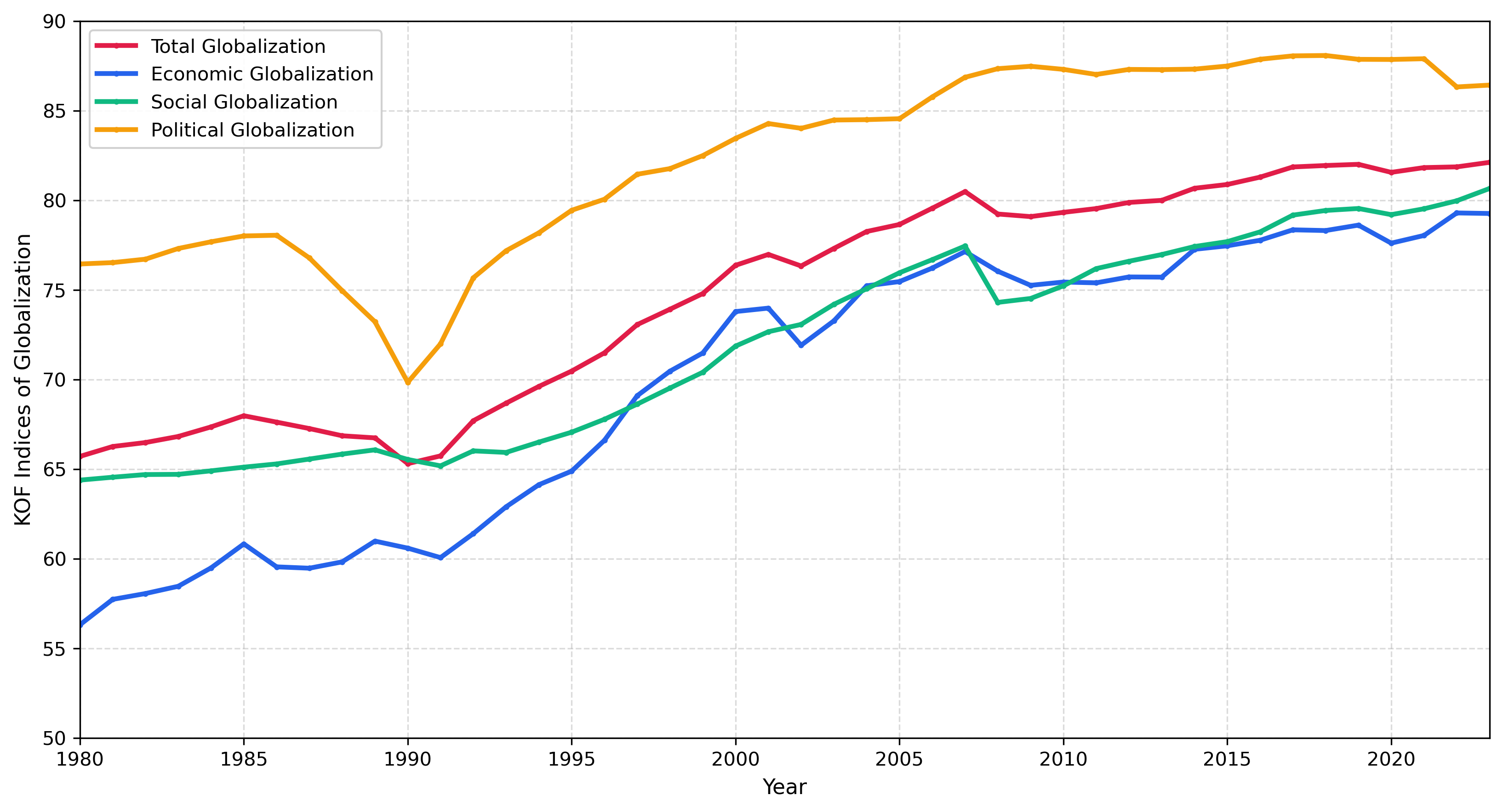
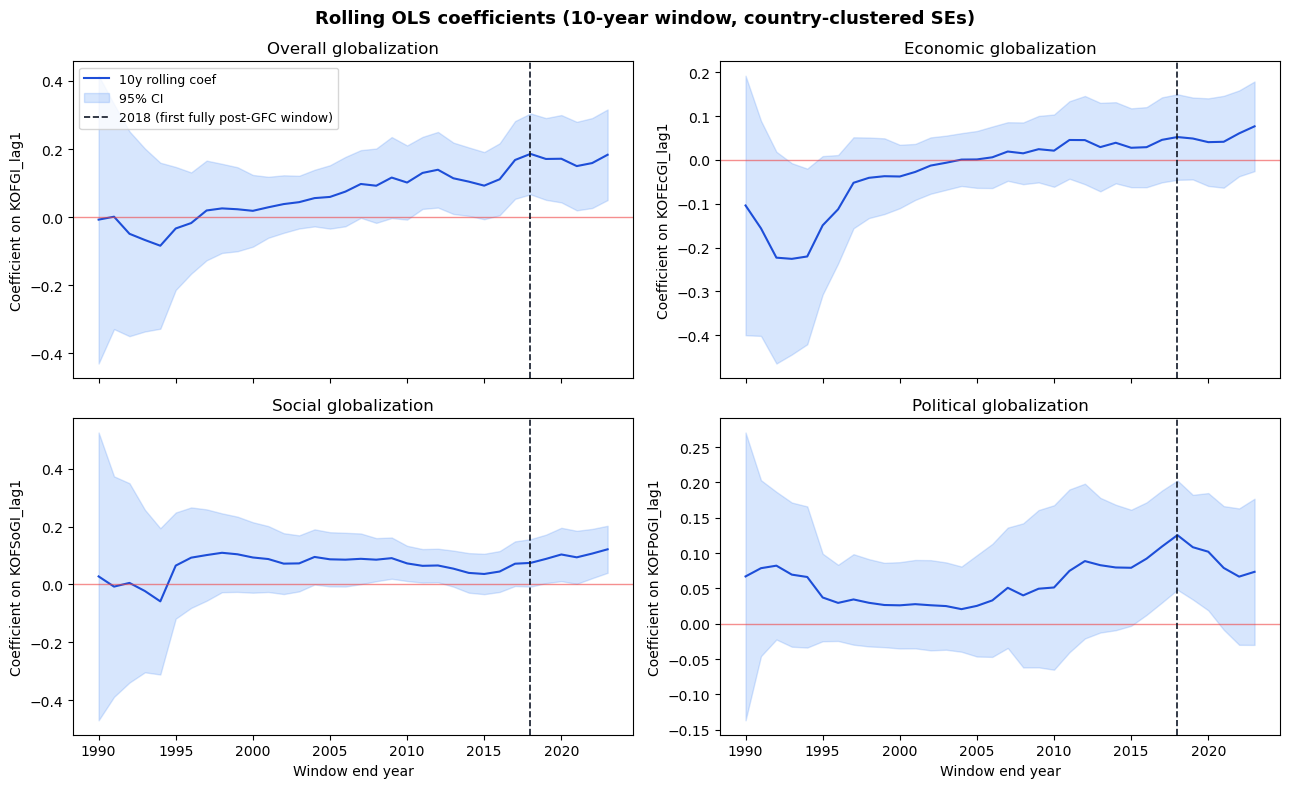
Seminar paper submitted June 2026. Panel data analysis of 32 OECD countries 1980–2023; rolling regressions uncover a structural break at 2008.
Master's Thesis
Monetary Policy & Economic Relations. Starts 20 August 2026, focusing on monetary policy in a post-COVID world.
Joint output
Globalization and the Welfare State
Economics of the Welfare State, University of Copenhagen. Supervisor: Amalie Sofie Jensen.
My role: Method and identification, residual diagnostics, rolling regressions, sub-period analysis, choice of standard errors and reverse causality.
Does GenAI Help Those Who Need It Most?
AI for Humanity, University of Copenhagen. Heterogeneous effects of generative AI in Danish upper-secondary schools.
One Rule to Rule Them All?
ECB monetary policy and asymmetric effects across the euro area. Supervisor: Michael Bergman.
Monetary Policy & Economic Relations
Starts 20 August 2026. Empirical analysis of monetary policy in a post-COVID world.
Methodology & Workflow
Data Engineering
Automated Python pipelines ensure reproducibility. We never clean data manually.
Econometrics
Rigorous identification in Stata. From simple OLS to GMM and structural VAR models.
Dissemination
LaTeX for academic papers, Astro for interactive web dashboards. Clarity is king.
Thesis Tracker
Monetary Policy & Economic Relations
Starts 20 August 2026 · expected submission January 2027
- 1 Literature Review Aug–Sep 2026
- 2 Data Collection Sep–Oct 2026
- 3 Model Validation Oct–Nov 2026
- 4 Drafting Nov 2026–Jan 2027
Data Scale
CPDS, KOF, OECD and the World Bank harmonised into one panel. N = 996 in the fully specified models. Globalization and the Welfare State.
Eurostat, OECD Economic Outlook and the ECB Statistical Data Warehouse. ECB Taylor Rules.
Structured and processed for SVAR estimation. Global Financial Cycle (bachelor's thesis).
Method coverage
How many of the four joint works use each method family. The axis runs 0 to 4.
What the group actually does
Five method families across four joint works, counted rather than self-rated.
- Panel data & FE — the welfare state seminar.
- Time series / VAR — the ECB project and the thesis.
- IV & GMM — the ECB project.
- Robustness & diagnostics — the ECB project and the welfare seminar.
- Survey & ML — the GenAI proposal.
The Knowledge Bank
11 works · shared Zotero library
Globalization and Its (Dis-)Content: Trade Shocks and Voting Behavior
Dippel, Gold, Heblich (2015) DOI
Importing Political Polarization? The Electoral Consequences of Rising Trade Exposure
Autor, Dorn, Hanson, Majlesi (2016) · NBER Working Papers
The European Trust Crisis and the Rise of Populism
Algan, Guriev, Papaioannou, Passari (2017) · Brookings Papers on Economic Activity
Globalization, Inequality and Welfare
Antràs, Gortari, Itskhoki (2016) DOI
Did Austerity Cause Brexit?
Fetzer (2019) · American Economic Review DOI
Globalization And The Welfare State
Garrett, Mitchell (1999)
Globalization and the welfare state
Yay, Aksoy (2018) · Quality & Quantity: International Journal of Methodology
Globalisation and the Future of the Welfare State
Chen, Görg, Görlich, Molana, Montagna, Temouri (2014) · IZA Policy Papers
Measuring the natural rate of interest: International trends and determinants
Holston, Laubach, Williams (2017) · Journal of International Economics DOI
Measuring the natural rate of interest: International trends and determinants
Holston, Laubach, Williams (2017) · Journal of International Economics DOI
The Stress of Having a Single Monetary Policy in Europe
Sturm, Wollmershaeuser (2008) · Social Science Research Network DOI
Gallery
The Stack 2.0
Stata
Python
LaTeX
DevOps
Open Science Pledge
We believe in transparency. All data cleaning is scripted rather than manual, so a dataset can be rebuilt from its sources. The welfare state seminar goes first: the whole pipeline is public on GitHub, with raw data, a Makefile, a Docker image and tests. The others will follow as they are prepared.
Network & Affiliation
-
University of Copenhagen
Department of Economics (ØI)
Academic Supervision
- Michael Bergman
Assoc. Professor. Supervisor on ECB Taylor Rules.
- Andreas Bjerre-Nielsen
Assoc. Professor. Supervisor on AI & SDS.
- Amalie Sofie Jensen
Supervisor on Globalization and the Welfare State (2026). Website ↗
Research Log
Rolling regressions & Chow test
Estimating the globalization coefficient over 10-year windows exposed parameter instability; a Chow test confirmed a structural break at 2008 for all four KOF indices.
OECD panel assembled
Harmonised CPDS, KOF, OECD and World Bank sources into a single panel covering 32 countries, 1980–2023.
Automating exchange rate data
Scripted the retrieval and harmonisation of exchange rate and price index series from Statistics Denmark, so the dataset can be rebuilt from scratch.
DuckDB in the workflow
Migrated larger datasets from CSV to DuckDB/Parquet for faster queries during the exploratory phase.
GMM estimation
Two-step GMM with lagged instruments implemented in Stata for the ECB project's Taylor rules.
import pandas as pd
from linearmodels.panel import PanelOLS

# 1. Balanced panel: 32 OECD countries, 1980–2023
panel = df.set_index(["country", "year"])
spec = "sstran ~ 1 + KOFGI_lag1 + ln_gdppc_lag1 + inflation_lag1" \
       " + deficit_lag1 + debt_lag1 + ln_pop_lag1 + dep_ratio_lag1" \
       " + EntityEffects + TimeEffects"

# 2. Rolling 10-year windows: each point is a separate estimation
for end in range(1989, 2024):
    years = range(end - 9, end + 1)
    window = panel.loc[panel.index.get_level_values("year").isin(years)]
    fit = PanelOLS.from_formula(spec, window).fit(
        cov_type="clustered", cluster_entity=True
    )
    print(end, fit.params["KOFGI_lag1"], fit.std_errors["KOFGI_lag1"])
Academic Curriculum (M.Sc. Econ)
Seminar – Economics of the Welfare State
Economics of the welfare state. Completed with the seminar paper behind this project.
Advanced Macroeconomics – Structural VAR
Identification, impulse responses and robustness in structural VAR models.
Advanced Macroeconomics – Business Cycles
Business cycle theory, DSGE models and macroeconomic fluctuations.
Applied Economic Modelling
Calibration, SAM, shocks and baseline checks. Tool: GAMS.